Written by: Haiqal Ubaidillah
Reviewed & Verified by: Muhammad Fareez Shah, Corporate Litigation Partner
Legal Reference: Companies Act 2016 (Act 777), High Court of Malaya Commercial Guidelines, and Suruhanjaya Syarikat Malaysia (SSM) Directives 2026.
Breach of Fiduciary Duty Director in Malaysia: Legal Consequences and Defenses (2026)
A breach of fiduciary duty by a director occurs when a corporate officer prioritizes their personal interests over the company's, fails to act in good faith, or misuses corporate assets, opportunities, or information. Under Malaysian corporate law, specifically Section 213 of the Companies Act 2016 (CA 2016), directors are legally bound to exercise their powers for a proper purpose and in the best interest of the company. They serve as trustees of the company's assets and are held to the highest standards of commercial probity.
When these duties are violated, the offending director faces severe, immediate liabilities. The consequences of a breach extend far beyond internal corporate reprimands; they trigger civil lawsuits from shareholders, statutory penalties enforced by the Suruhanjaya Syarikat Malaysia (SSM), multi-million ringgit fines, and up to five years of imprisonment. Whether you are a shareholder seeking to protect corporate assets or a director defending against allegations of misconduct, understanding the precise statutory boundaries of fiduciary obligations is critical to navigating corporate litigation in Malaysia.
What Is a Breach of Fiduciary Duty? (Key Differences Summary)
To effectively identify or defend against a claim, stakeholders must distinguish the core statutory triggers:
- Utmost Good Faith: Directors must act honestly and prioritize the company's interests above their own or those of any third party.
- Conflict of Interest: A breach occurs the moment a director’s personal interests clash with their duties to the company, regardless of whether the company actually suffered a financial loss.
- Improper Purpose: Exercising directorial powers (such as issuing shares) to manipulate voting control or defeat a takeover bid, rather than for raising capital, constitutes a direct breach.
- Secret Profits: Directors are strictly prohibited from making undisclosed profits from their position. Any such profit must be accounted for and returned to the company.
- Statutory Liability: Unlike the older Companies Act 1965, the Companies Act 2016 explicitly codifies fiduciary duties, carrying harsher criminal penalties and removing previous loopholes regarding the delegation of authority.
The Statutory Anchors: Companies Act 2016
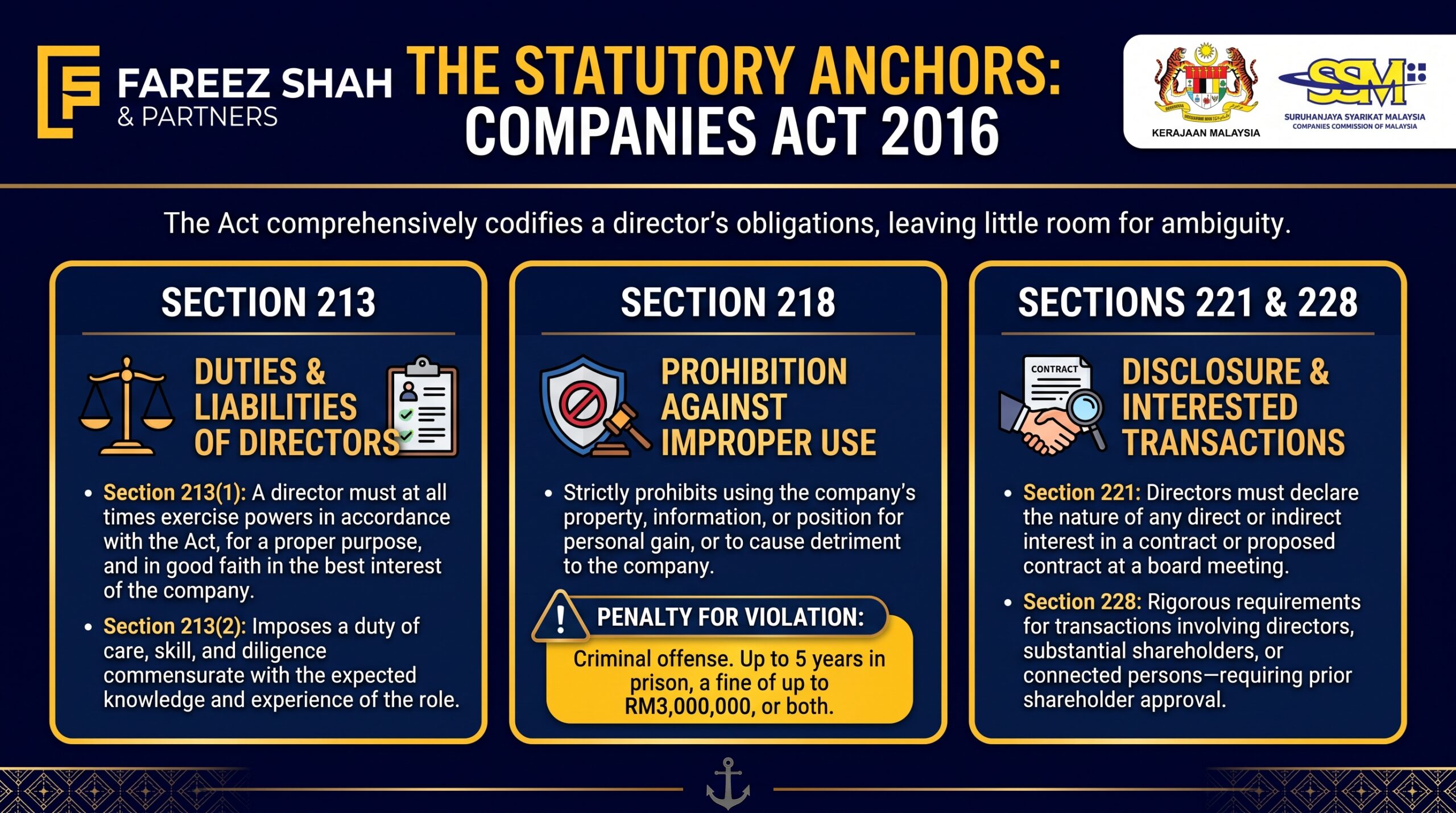
Malaysian corporate law does not rely solely on common law principles to define a director's responsibilities. The Companies Act 2016 comprehensively codifies these obligations, leaving little room for ambiguity.
Section 213: Duties and Liabilities of Directors
Section 213(1) states that a director of a company shall at all times exercise his powers in accordance with this Act, for a proper purpose and in good faith in the best interest of the company. Section 213(2) further imposes a duty of care, skill, and diligence commensurate with the knowledge, skill, and experience which may reasonably be expected of a director having the same responsibilities.
Section 218: Prohibition Against Improper Use of Property and Position
This section is frequently invoked in breach of fiduciary duty litigation. Section 218 strictly prohibits a director from utilizing the company’s property, corporate information, or their position to gain a direct or indirect benefit for themselves or any other person, or to cause detriment to the company. A violation here is a criminal offense punishable by up to 5 years in prison or a fine of up to RM3,000,000, or both.
Sections 221 and 228: Disclosure and Interested Transactions
Section 221 mandates that directors who are directly or indirectly interested in a contract or proposed contract with the company must declare the nature of their interest at a meeting of the board of directors. Section 228 sets rigorous requirements for transactions involving directors, substantial shareholders, or connected persons, requiring prior shareholder approval to validate such transactions.
Comparative Analysis: Types of Fiduciary Breaches
To effectively identify or defend against a claim, stakeholders must distinguish between the common types of fiduciary breaches and their corresponding statutory triggers.
| Type of Breach | Common Law Principle | CA 2016 Statutory Trigger | Typical Scenario |
|---|---|---|---|
| Misappropriation of Assets | Constructive Trust | Section 218(1)(a) | Transferring company funds or IP to a personal shell company. |
| Usurping Corporate Opportunity | No Profit Rule | Section 218(1)(c) | Diverting a lucrative contract intended for the company to a rival firm owned by the director's spouse. |
| Undisclosed Conflict of Interest | No Conflict Rule | Section 221 & 222 | Approving a vendor contract with a company where the director holds hidden shares. |
| Acting for Improper Purpose | Proper Purpose Doctrine | Section 213(1) | Issuing new shares solely to dilute a majority shareholder's voting power before an AGM. |
Consequences of a Breach: Civil vs. Criminal Liability
A breach of fiduciary duty by a director in Malaysia exposes the individual to a dual-track liability system. The company (often mobilized by a newly appointed board or via a shareholder derivative action under Section 347) can pursue civil remedies, while the SSM can initiate criminal prosecution.
Civil Remedies Available to the Company
- 1 Account of Profits: The director must surrender all unauthorized profits made as a result of the breach back to the company. The courts do not care if the company itself could not have made the profit; the mere fact that the director profited from their position is sufficient.
- 2 Damages / Equitable Compensation: If the company suffered a financial loss due to the director's actions (e.g., selling an asset below market value to a connected party), the director is personally liable to compensate the company for that exact deficit.
- 3 Rescission of Contracts: Contracts entered into by the company as a result of a director's breach (such as a highly biased lease agreement) are voidable at the option of the company.
- 4 Injunctions: The company can seek immediate court orders to freeze the director's assets (Mareva Injunction) or stop an impending transaction that violates fiduciary duties.
Statutory Penalties and SSM Enforcement
The Companies Act 2016 severely escalated the punitive measures for directors who treat corporate assets as their own.
| CA 2016 Section | Offense Description | Maximum Penalty |
|---|---|---|
| Section 213(3) | Failure to act in good faith / best interest | RM3,000,000 fine or 5 years imprisonment, or both. |
| Section 214(2) | Improper reliance on Business Judgment Rule | RM3,000,000 fine or 5 years imprisonment, or both. |
| Section 218(2) | Improper use of company property/information | RM3,000,000 fine or 5 years imprisonment, or both. |
| Section 221(12) | Failure to disclose interest in contracts | RM3,000,000 fine or 5 years imprisonment, or both. |
Defenses and Safe Harbors for Directors
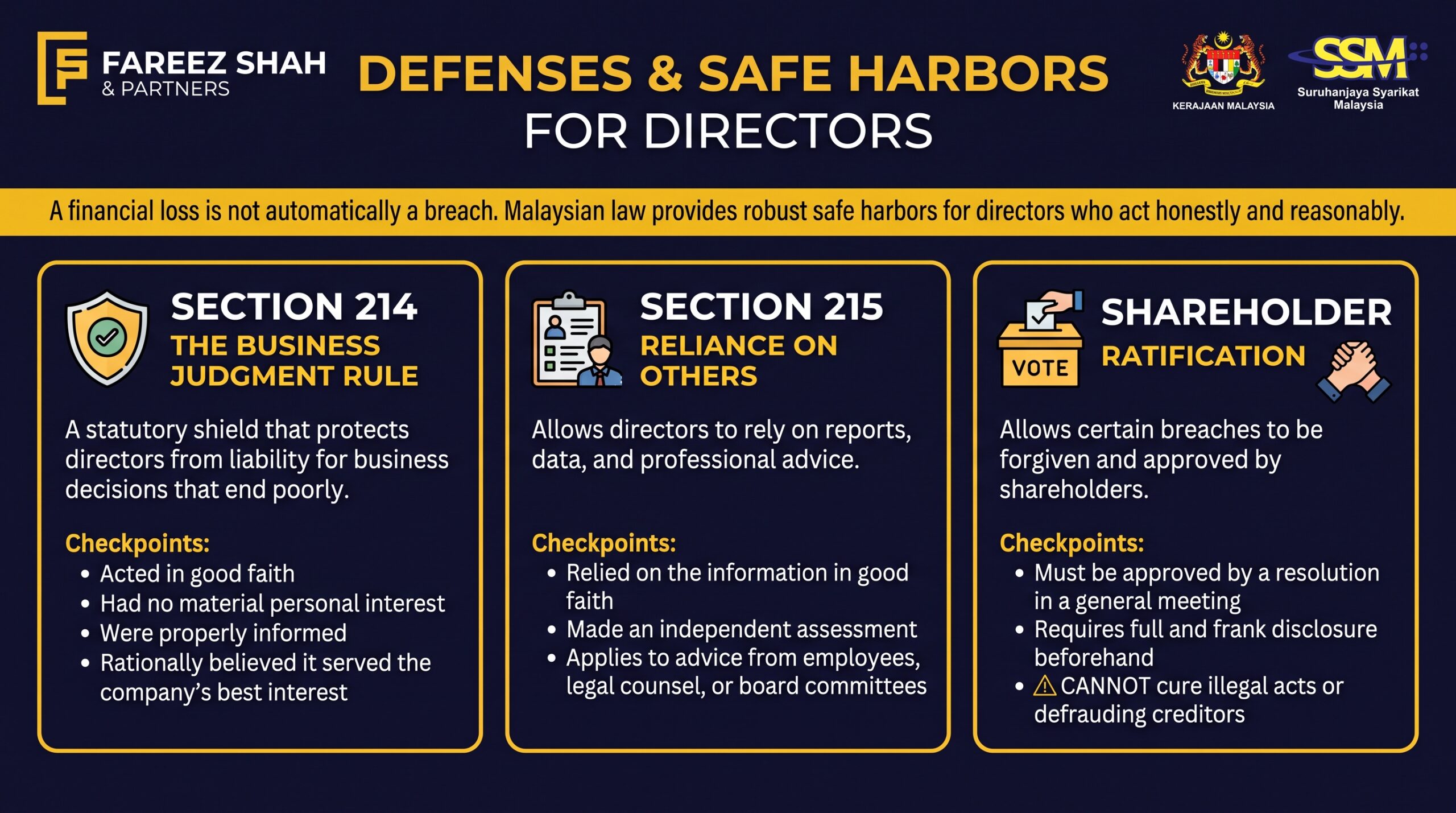
Accusations of a breach of fiduciary duty are devastating, but they are not always merited. Directors frequently make high-stakes, risky decisions that result in financial loss for the company. A financial loss is not automatically a breach of fiduciary duty. Malaysian law provides robust safe harbors to protect directors who act honestly and reasonably.
📌 The Business Judgment Rule (Section 214): This statutory shield protects directors from liability for business decisions that end poorly. To invoke this defense, a director must prove they acted in good faith, had no material personal interest, were properly informed, and rationally believed the judgment was in the best interest of the company.
- Reliance on Section 215: Allows directors to rely on reports, statements, financial data, and professional advice prepared by employees, legal counsel, or board committees, provided they relied on it in good faith and made an independent assessment.
- Ratification Shareholder Ratification: In certain common law scenarios, a breach can be forgiven and approved by a resolution of the shareholders in a general meeting, provided full and frank disclosure was made. This cannot cure illegal acts or acts defrauding creditors.
Actionable Steps for Stakeholders
For Shareholders and Boards Discovering a Breach:
Time is of the essence to prevent the dissipation of assets. The board should immediately suspend the offending director's executive powers and access to corporate bank accounts. Engage commercial litigators to file for pre-action discovery or freezing injunctions. If the board refuses to act, minority shareholders should invoke Section 347 of the CA 2016 to commence a Statutory Derivative Action.
For Directors Facing Allegations:
Do not destroy documents, internal emails, or WhatsApp communications. Secure all minutes of board meetings and board papers that demonstrate your decision-making process. The primary line of defense will rely heavily on contemporaneous documentation proving your actions were commercially justified and properly disclosed under Section 221.
Frequently Asked Questions (FAQ)
Q: What constitutes a breach of fiduciary duty by a director in Malaysia?
Q: Can a director face jail time for breaching fiduciary duties?
Q: What is the Business Judgment Rule?
Q: Can shareholders sue a director directly for a breach of duty?
Q: Is a financial loss automatically considered a breach of fiduciary duty?
Protect Your Corporate Interests Today
Corporate governance in Malaysia is highly regulated, and the courts take a strict, unforgiving approach to executives who exploit their positions. Precision in compliance, exhaustive documentation, and immediate legal intervention are the only reliable mechanisms to manage fiduciary risks. Speak to our corporate litigation team to audit your board decisions or initiate recovery actions.